Four Corners
It started with a magnolia tree.
Elizabeth Dent-Sumrall had just finished dining at Cocha, a downtown Baton Rouge restaurant, when she noticed something happening outside. Enrique Piñerua, who owns the restaurant with his wife, Saskia Spanhoff, was working with gardeners to plant a magnolia tree and flowers near the restaurant.

The couple opened Cocha in 2016, bringing a globally inspired menu featuring locally sourced ingredients to downtown Baton Rouge. They've also invested in beautifying the area around their restaurant, including the addition of an outdoor parklet designed to create a more inviting streetscape. Source: 225 Magazine
Dent-Sumrall, who has deep family ties to Baton Rouge's earliest days, had been thinking about another nearby area that could use some attention: the four corners of Main and Fourth streets, historically known as Gras Devall Plaza.
She struck up a conversation with Piñerua and shared her idea for beautifying the intersection. The two walked down to the plaza, and he agreed to help.
What began as a conversation outside a restaurant soon grew into a volunteer effort to restore attention and pride to a place that has been part of Baton Rouge's history for more than two centuries.

For Dent-Sumrall, the project is more than a neighborhood beautification effort. It's personal. She is a descendant of the Gras family, whose name has been associated with the plaza since its establishment in 1809.
And now, more than 200 years later, she's helping write its next chapter.
Four corners with more than 200 years of history
Today, the intersection of Main and North Fourth streets might seem like just another downtown crossing. But in the early 19th century, it was an important gathering place for the growing community.
According to a historical marker erected by the City of Baton Rouge, the four corners were dedicated for public use in 1809 by Antonio Gras and Edith and Richard Devall.
The arrangement called for a market in the center of the intersection, with the surrounding corners used for hitching horses and wagons. It was a practical gathering place in an era when farmers, merchants and travelers relied on horses and wagons to transport goods and conduct business.
The plaza's name preserves the families' connection to that early chapter of Baton Rouge history.
Dent-Sumrall's ancestor, Don Antonio de Gras, was a Spanish landowner who settled in Baton Rouge in the late 1700s. According to the family history shared by Dent-Sumrall, he came from Palma de Mallorca, Spain, with Spanish land grants. Richard Devall, another early resident whose family name is associated with the plaza, came from Liverpool, England, according to her account.
The plaza was established during a period of significant political change. Baton Rouge was still under Spanish control in 1809. Just one year later, settlers rebelled against Spanish rule in what became known as the West Florida Rebellion.
As the town grew and changed hands, the four corners remained.
A connection to one of Baton Rouge's oldest churches
Just steps from Gras Devall Plaza stands St. Joseph Cathedral, another landmark with ties to Antonio de Gras.
The Catholic parish was established in 1792 under Spanish rule and originally named Nuestra Señora de los Dolores, or Our Lady of Sorrows. Its history extends to an earlier chapel constructed before the parish was formally established.
According to the Diocese of Baton Rouge, Antonio de Gras married Genevieve Dulat on January 15, 1793, in what is recognized as the first recorded marriage in Baton Rouge. That same year, de Gras donated land for the construction of a new church.
As the congregation grew, a larger church was constructed in 1830 on property acquired from de Gras and businessman William S. Pike. The present cathedral building dates to the 1850s.
The connection illustrates how closely the city's early religious, commercial and civic development was intertwined.
The same families whose names appear in the history of the plaza also helped shape the surrounding community.
A volunteer effort takes shape
Back in the present day, Dent-Sumrall's idea for Gras Devall Plaza quickly attracted support.
After Piñerua agreed to help, she contacted her friend Jennifer Richardson, founder of Keep Tiger Town Beautiful, a nonprofit organization dedicated to cleaning up and beautifying Baton Rouge.
Richardson started the organization in 2021, bringing together volunteers who spend their free time picking up litter and tackling neglected areas throughout the city. The group organizes regular community cleanups and provides resources for residents who want to take on projects of their own.
Richardson joined the plaza effort, and additional volunteers soon followed. Bryan contributed pressure-washing equipment, Kristen brought her talents as a muralist, and a group of men from a sober living community joined the work.


Together, the volunteers began cleaning and improving an area that Dent-Sumrall described as neglected, with tall weeds and litter.
The work is intended to do more than improve the appearance of the intersection. The group hopes to make Gras Devall Plaza a more recognizable historic landmark and a place where residents and visitors can appreciate its significance.
In her October 19 presentation, Dent-Sumrall explained the group's larger goal:
"Our goal is to connect the past and the present to instill a new sense of pride for the citizens to embrace the rich history of Baton Rouge."
A history lesson on two wheels
We first learned about the Gras Devall Plaza project through the Downtown Development District, which has been working on broader efforts to revitalize downtown Baton Rouge.
I met Elizabeth Dent-Sumrall at the DDD's October meeting, where I learned about the volunteer project and the history behind the intersection. It seemed like a perfect opportunity to bring the Downtown East Social Ride to the plaza to hear the story firsthand.
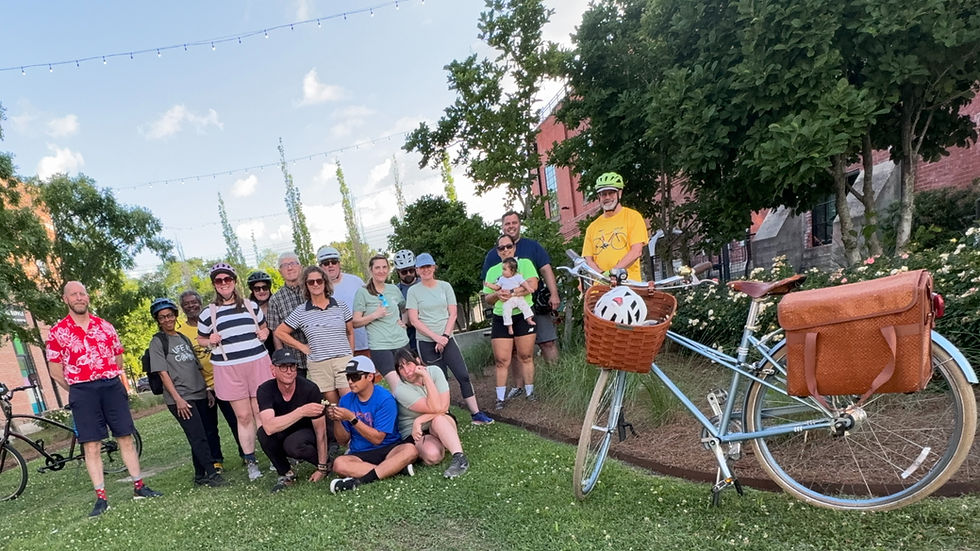
On Monday, October 19, our group rode downtown to meet Dent-Sumrall and several of the people helping bring her vision to life.


Richardson, Piñerua and Kristen joined Elizabeth to share their respective roles in the project and talk about the work being done to restore the plaza.
For our ride, it was another opportunity to explore a familiar part of Baton Rouge from a different perspective. We've passed through this area countless times, but there's a difference between riding past a historic landmark and stopping to learn why it's there.
It's also a reminder of how much history is hiding in plain sight throughout downtown Baton Rouge.
Part of a bigger vision for downtown
Although the Gras Devall Plaza improvements are being led by volunteers rather than the Downtown Development District, the project fits into a much larger conversation about the future of downtown Baton Rouge.
In May 2026, the DDD unveiled Plan Baton Rouge III, an updated master plan intended to guide downtown development over the coming years.
The plan builds on previous downtown revitalization efforts and emphasizes creating more walkable neighborhoods, improving public spaces, connecting cultural and historic landmarks, and making downtown a more attractive place to live, work and visit.
It also identifies opportunities to strengthen connections between neighborhoods, expand housing and improve access for pedestrians, bicyclists and other forms of transportation.
Projects like Gras Devall Plaza demonstrate how smaller, grassroots efforts can complement those larger plans.
While major investments in infrastructure and development are important, so are the smaller improvements that make a neighborhood feel cared for. Cleaning up a neglected corner, planting flowers, creating public art and sharing the history of a place can all contribute to how people experience their city.
And sometimes those efforts can happen without waiting for a major public project to get underway.
Connecting the past and present
The history of Gras Devall Plaza is part of a much longer story.
Long before the intersection existed, the area that would become Baton Rouge was home to Indigenous peoples. In 1699, French explorer Pierre Le Moyne d'Iberville recorded a red pole marking a boundary between the hunting grounds of the Houma and Bayougoula peoples.
That landmark became associated with the name le bâton rouge, or red stick, from which the city takes its name.
Over the centuries that followed, Baton Rouge experienced Spanish, British and American rule, the West Florida Rebellion, the establishment of the state capital and the upheaval of the Civil War.
Through those changes, the intersection at Fourth and Main remained part of the city's evolving landscape.
The horses and wagons are long gone, and the intersection no longer serves as a central marketplace. But the history is still there, even if many people passing through don't know it.
That's what Dent-Sumrall and her fellow volunteers hope to change.
Their vision is to transform Gras Devall Plaza into a place that encourages people to stop, look around and learn something about the city around them.
It's an effort rooted in the belief that preserving history doesn't always require a major construction project or a large organization. Sometimes, it starts with a few people willing to roll up their sleeves.
And in this case, a magnolia tree and a conversation outside a restaurant.


Comments