Mike The Tiger
Updated: Apr 7
On any given day in Baton Rouge, you can walk across Louisiana State University’s campus, pass Tiger Stadium, and find yourself standing face to face with a tiger.
For nearly ninety years, LSU has maintained one of the most unusual traditions in college athletics, a live Bengal tiger mascot known simply as Mike. Generations of students, football fans, and visitors have gathered along North Stadium Drive to watch him pace through his habitat. For many people, it is their first close encounter with a tiger. For LSU, it is a living symbol of the school’s identity.
The story of Mike the Tiger begins in the mid 1930s, when LSU was still growing into the flagship university it would eventually become, and when school spirit was taking on new forms across American college campuses.
The Idea That Changed LSU
The idea for a live tiger began with Chellis “Mike” Chambers, an athletic trainer at LSU. Around 1934, Chambers and several others on campus began discussing the possibility of bringing a real tiger to represent the university’s “Tigers” nickname. Joining him in the effort were athletic director T. P. Heard, intramural coach William “Hickey” Higginbotham, and LSU law student Ed Laborde.
The plan was simple. Ask every LSU student to contribute a quarter.
The campaign worked almost immediately. Students raised $750, enough to purchase a one year old tiger cub from the Little Rock Zoo in Arkansas.
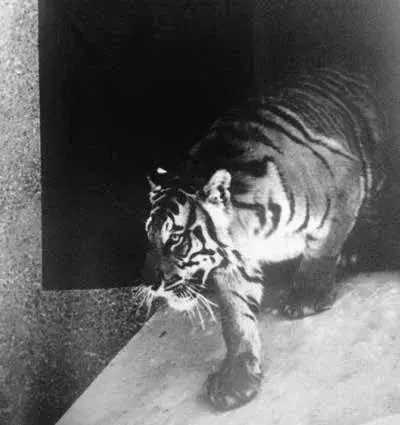
The cub had been born on October 10, 1935, and originally carried the name Sheik. Once the animal arrived in Baton Rouge, the name was changed to Mike, honoring Chambers, the man most responsible for bringing the tiger to LSU.
On the morning of October 21, 1936, the tiger arrived in Baton Rouge by train. Students lined Highland Road to watch the procession escort the animal to campus, turning the arrival into an impromptu celebration.
From that moment forward, LSU had a living mascot.
Mike I Becomes an LSU Legend
The first Mike quickly became one of the most recognizable figures on campus.
Within days of arriving, he was already traveling with LSU teams and appearing at athletic events. The tiger’s presence helped cement LSU’s identity as the “Tigers,” a nickname the university had adopted decades earlier in 1896.
Mike I remained LSU’s mascot for nearly twenty years. During that time he became one of the most visible symbols of LSU athletics and campus life. When he died on June 29, 1956, at the age of twenty, the loss was deeply felt by students and alumni.
Today, the preserved form of the original Mike remains on display at LSU’s Museum of Natural Science, a reminder of the tiger that started the tradition.
The Line of Tigers
After the death of the original tiger, LSU made it clear the tradition would continue.
Each new tiger would carry the same name, Mike, followed by a Roman numeral. Over time, the succession of animals became its own piece of LSU history.
The second tiger, Mike II, arrived from the Audubon Zoo in New Orleans in 1956 and was unveiled to fans on the opening day of football season.
Several other tigers followed:
Mike III served from 1958 until 1976 and became one of the longest reigning mascots.
Mike IV lived on campus from 1976 to 1990.
Mike V, perhaps the most widely photographed tiger of the modern era, represented LSU from 1990 until 2007.
Mike VI arrived from a wildlife sanctuary in Indiana and served until 2016.
Mike VII, the current tiger, arrived in Baton Rouge in 2017 after being donated from a Florida wildlife rescue facility.
Each tiger carries the same name, reinforcing the sense that the mascot is less an individual animal and more a continuing role within LSU’s traditions.
Where Mike Lives
Early versions of Mike’s enclosure were modest by modern standards. The first habitat built in 1936 covered only about 2,000 square feet and consisted mainly of a caged enclosure with a small structure and climbing logs.
In 2005, LSU unveiled a dramatically expanded habitat near Tiger Stadium. The new facility covers roughly 15,000 square feet and includes landscaping, rock formations, a waterfall, and a flowing stream designed to mimic a natural environment.
The habitat sits between Tiger Stadium and the Pete Maravich Assembly Center, placing the tiger at the physical center of LSU athletics.
The enclosure also serves educational and conservation roles, with LSU’s veterinary school involved in the animal’s care and research programs tied to the habitat.
A Baton Rouge Tradition
In earlier decades, Mike would sometimes be transported to Tiger Stadium on game day, where the roar of the crowd and the presence of the live tiger helped amplify the spectacle of LSU football.
Today the tradition has evolved, and Mike remains in his habitat rather than being brought into the stadium environment. But the connection between the tiger and LSU athletics remains just as strong.
Visitors still gather outside the habitat daily. Students take photos with Mike on graduation day. Tour groups stop to watch him pace beneath the oak trees.
The tiger has become part of the landscape of Baton Rouge itself.
For nearly ninety years, the line of Mikes has represented LSU pride, school spirit, and one of the most unusual traditions in American college sports. What began as a quarter-per-student fundraiser in the 1930s became a living symbol that continues to define LSU and the city that surrounds it.


Comments